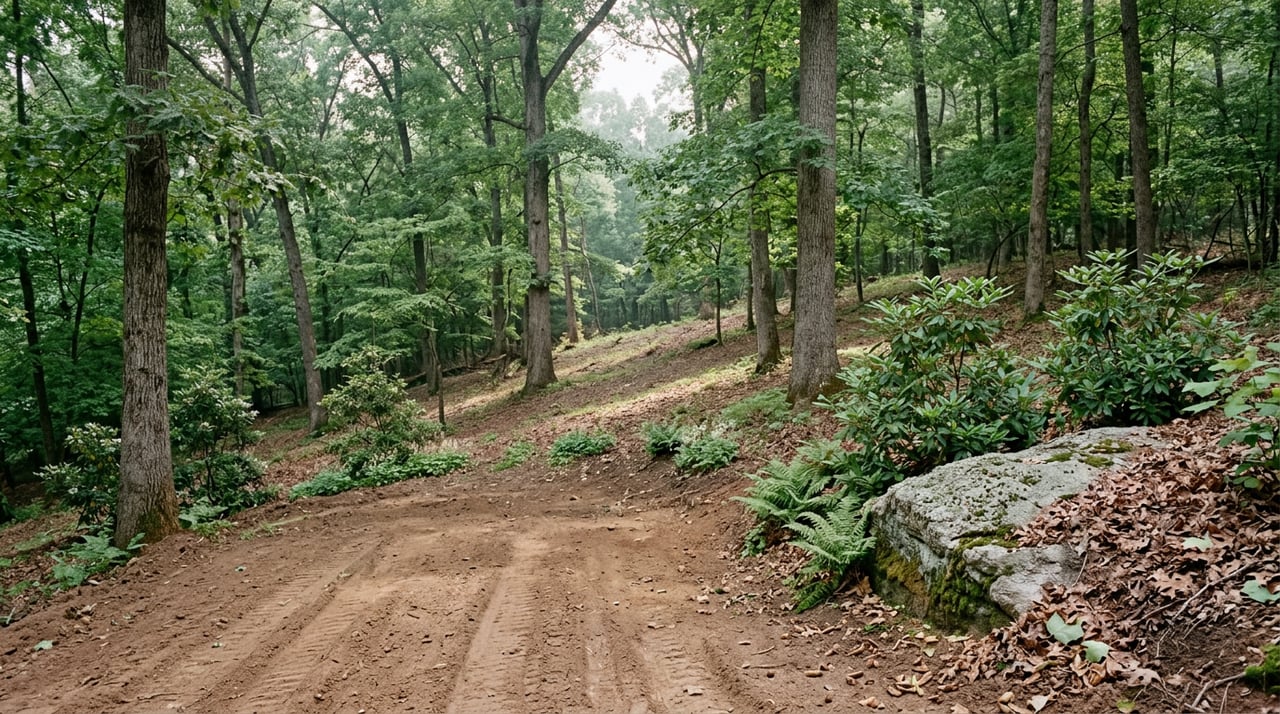
Two lots went up for sale in Gilmer County this year, both inside a few miles of downtown Ellijay. One is a 1.6-acre platted lot on Oak Ridge Way, listed at $40,000. The other is part of a developer closeout sale advertising creek and mountain-view parcels up to four-plus acres starting at $12,900. Same county, same rough drive time to the Piggly Wiggly, and the smaller lot costs more.
If you're used to reading real estate the way most portals present it, the instinct is to hunt for a quality difference. Better view. Closer to Carters Lake. Some hidden zoning advantage. The actual answer has almost nothing to do with the dirt itself. It has to do with what's already run to the property line before you ever show up, and Gilmer County's own regulations are the reason that single fact moves the price more than acreage does.
The Line Item That Actually Sets the Floor
Georgia regulates septic systems at the county level, and Gilmer County's Environmental Health Division publishes a minimum lot size table that most buyers never see until they're already under contract. A lot served by public or community water only needs to be three-quarters of an acre to qualify for a septic permit. A lot on an individual well needs meaningfully more, and once the ground's slope crosses 35 percent, the county doesn't care what your water source is. The floor jumps to three acres.
That rule is the quiet engine behind the price gap. A legacy resort community platted decades ago on county or community water can carve lots down to half an acre and still legally permit a home on each one. A raw parcel out in the unrestricted county, with no water main anywhere near it, has to be big enough to accommodate a well and a septic drain field on its own, which is exactly why so many of those bargain-priced four-acre and five-acre listings you'll find advertised around Ellijay aren't generous. They're the minimum size the county will allow, dressed up as a feature.
Coosawattee River Resort is the clearest example of the other side of that trade. The gated community spans more than 5,500 acres along the Coosawattee River and Mountaintown Creek, platted into roughly 7,000 lots that average a half to three-quarter acre apiece, with county water reaching parts of the resort. Lots there currently list around $47,000 on average, for a fraction of the acreage a well-and-septic buyer would need just to break ground on raw land a few miles outside the gates.
Why the "Average Price Per Acre" You Find Online Doesn't Agree With Itself
If you've already searched for a per-acre benchmark for Gilmer County, you've probably noticed the numbers don't line up. One widely cited land-market source puts the median at $19,427 an acre, but its own disclaimer says that figure is calculated only from listings over 10 acres, with an average lot size of 39 acres. A different aggregator, pulling from a broader mix of 952 active listings that includes small platted lots, lands on $53,610 an acre. Nearly a three-times gap, from the same county, in the same season.
That's not sloppy data. It's the water-source split showing up in the math. Filter for only the big unrestricted tracts and you get a low number, because those properties are priced the way raw acreage prices: by the acre, with land doing most of the work. Include the small legacy resort lots that sit on county water and infrastructure someone else already paid for, and the average climbs, because those lots are priced by the lot, not by the acre. Neither number is wrong. They're measuring different inventories that happen to share a county line.
Elevation Adds Its Own Paperwork
Water source sets the acreage floor, but Gilmer County has a second trigger that matters if you're shopping ridge lots for the view. Any parcel 2,200 feet or higher in elevation with at least 25 percent slope sustained over 500 horizontal feet falls inside what the county calls a mountain protection district. Building there requires a land-disturbance permit with a site plan meeting the county's specific standards, on top of the standard septic and building permits.
This isn't a reason to avoid a ridge lot. Some of the most requested views in Gilmer County sit exactly in this zone. It's a reason to ask your agent, before you write an offer, whether the specific parcel falls inside a mountain protection district, and to budget the extra permitting step into your build timeline rather than discovering it after closing.
The Permit Fee Nobody Explains Until You're Filing It
Here's a detail that catches people off guard if they've shopped land in a neighboring county first: Gilmer County's septic permit fee schedule is set by the total square footage of the structure, not by bedroom count. As of the county health department's current application packet, the fee runs $150 for a home of 1,000 square feet or less, climbs to $250 between 1,001 and 2,000 square feet, $350 up to 3,000 square feet, $400 up to 5,000 square feet, and $500 above that. The total includes basements and bonus rooms, finished or not.
If you've cross-shopped land in Big Canoe, where permits track differently, this is worth flagging early with your builder rather than assuming the paperwork transfers county to county. It's a small dollar figure either way, but it's one more example of how much of what actually governs your build cost in Gilmer County is set by a county office, not by the listing price of the lot.
What Apple Season Does to a Drain Field
There's a seasonal wrinkle specific to Gilmer County that doesn't show up in any acreage table. Ellijay carries the apple capital title for a reason, and every fall the orchards, cider houses, and farm stands that draw visitors sit on the same private septic systems as the houses around them, because none of it is on a municipal sewer line. Local septic contractors describe a predictable pattern: a system that handles a normal July without complaint gets pushed past its design capacity by the third weekend of October, when cabin turnover and orchard traffic both peak at once. Soil conditions vary sharply across the county too, with wetter river-bottom ground along the Cartecay and Ellijay rivers behaving differently under load than the thin, rocky soil higher on the ridges.
If you're buying a cabin or building one with short-term rental income in mind, this matters twice over. First, ask what the property's system was actually sized for, and whether that sizing anticipated guest turnover or just a single household. Second, know that Gilmer County now requires short-term rental properties to be registered with the county, a requirement that took effect with a registration deadline in mid-2025 and applies whether the home is new to you or has been renting for years.
Before You Write an Offer on Raw Land
A few steps are worth taking before you're emotionally attached to a specific parcel:
- Confirm the water source in writing. "Community water available" and "individual well required" are two different acreage conversations under county rules, and the listing description doesn't always spell it out clearly.
- Ask whether the parcel sits inside a mountain protection district, particularly on ridge or view lots above roughly 2,200 feet.
- Order a Level 2 soil survey for due diligence before you're under a tight contract deadline. It won't get you a permit on its own, but it tells you whether the ground is likely to qualify before you pay for the Level 3 survey a permit actually requires. Full Level 3 results typically take two to three weeks, though smaller parcels of three acres or less can often be turned around in a single day once the fieldwork is done.
- If short-term rental income is part of your plan, confirm the county's current registration requirement applies to the property and factor that into your timeline.
A Few Questions Worth Asking Directly
Does a bigger lot always mean a lower price per acre in Gilmer County? Not reliably. A large unrestricted parcel priced cheap by the acre may simply be sized to meet the well-and-septic minimum, while a small legacy lot in an established community can carry a higher total price because it already sits on water infrastructure someone else built decades ago.
Is a well-and-septic lot a worse investment than a community-water lot? Not inherently. It's a different cost structure. You're paying less per lot upfront in many cases, but budgeting for your own well, your own septic system, and the acreage the county requires to support both.
Can I find out a parcel's water source before making an offer? Yes, and you should. Ask the listing agent directly and confirm it against the county's own minimum lot size regulations rather than relying on marketing language alone.
If you're comparing land in Ellijay against other North Georgia markets, or trying to figure out what a specific parcel's water source and slope actually mean for your build budget, that's exactly the kind of question worth working through before you write an offer, not after. Thomas Petrigliano can walk you through what a specific lot's numbers actually tell you, and help you compare it honestly against other communities you're considering.